Each brand's flagship tower, built on opposite ideas. The Klipsch RF-7 III is a 2-way with two 10-inch woofers and a 1.75-inch titanium compression driver on a large Tractrix horn, rated at 100 dB, with an enclosure made in Hope, Arkansas. The Aperion Grandis GR8T is a 3-way with a dedicated 3-inch soft-dome midrange and a silk tweeter in a waveguide, and at about $5,499 per speaker, roughly $11,000 a pair, it costs more than twice as much as the Klipsch's ~$4,900 a pair.
Buy the Klipsch RF-7 III (~$4,900 a pair) for maximum dynamics and output, especially in a big theater room. At 100 dB and 8 ohms it plays very loud from modest power, and it comes in real wood veneer.
Buy the Aperion Grandis GR8T (~$5,499 each) for a refined 3-way stereo pair or front stage driven by a strong amplifier. It's rated from 28 Hz to 42 kHz, but at 89 dB and 4 ohms it needs real power.
- ~$4,900 a pair Check price on Amazon
-
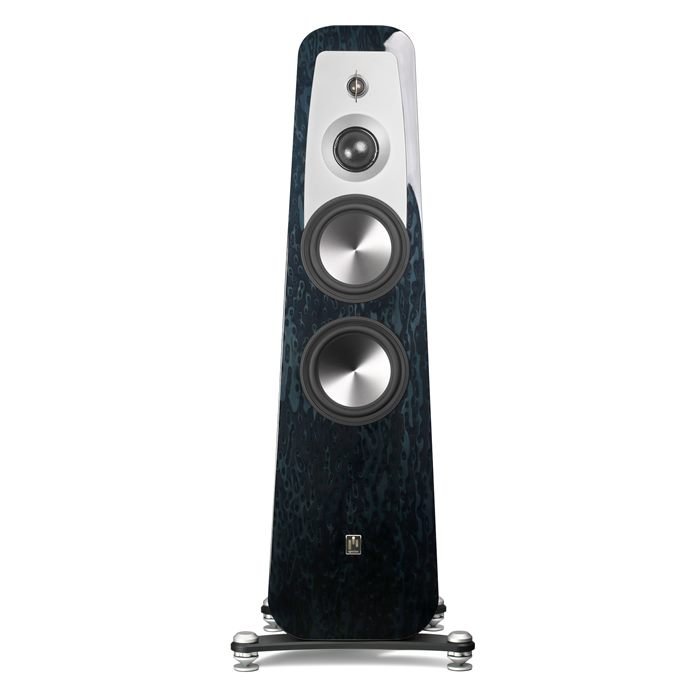 ~$5,499 each
Check price at Aperion Audio
Prices are approximate and change often. Tap a name for the full write-up, or see the specs table. Images: Aperion Audio.
Specs side by side
| Klipsch RF-7 III | Aperion Grandis GR8T | |
|---|---|---|
| Price | ~$4,900 a pair (about $2,450 each) | ~$5,499 each (about $11,000 a pair) |
| Design | 2-way, dual-chamber, dual rear Tractrix ports | 3-way, rear-ported |
| Tweeter | 1.75" titanium compression driver on an 8.5" 90° × 90° Tractrix horn | 1.1" silk dome in a Saturn waveguide |
| Midrange | None (the woofers cover it) | 3" soft dome |
| Woofers | Two 10" Cerametallic, cast aluminum frames | Two 8" A.F.G. long-throw |
| Response (±3 dB) | 32 Hz–25 kHz | 28 Hz–42 kHz |
| Sensitivity | 100 dB | 89 dB |
| Impedance | 8 ohms | 4 ohms |
| Power | 250W continuous, 1,000W peak | 20–300W recommended, 600W peak |
| Size (H × W × D) | 49 × 13.875 × 17.875 in (with plinth) | 49.6 × 13.1 × 13.8 in |
| Weight | 97 lb each | 108 lb each |
| Terminals | Bi-wire / bi-amp | Not specified |
| Finishes | Black ash, cherry, or walnut wood veneer | Rosewood opal or blue opal gloss veneer |
| Where to buy | Amazon and Klipsch dealers | Direct from Aperion |
| Trial | Retailer's return policy | 30-day in-home audition |
Specs are from Klipsch's spec sheets and Aperion's product pages. Klipsch measures sensitivity in-room and Aperion doesn't say how it measures, so treat the sensitivity gap as approximate. Prices are approximate and change often.
2-way horn vs true 3-way
The RF-7 III takes the 2-way idea as far as Klipsch's Reference line goes: two 10" Cerametallic woofers on cast aluminum frames handle bass and midrange, and a 1.75" titanium compression driver on an 8.5-inch Tractrix horn takes over at 1,300 Hz. A compression driver is the kind of tweeter used in cinema speakers, and it's a big reason the RF-7 III is rated at 100 dB.
The Grandis GR8T is a true 3-way. Two 8" long-throw woofers handle bass, a dedicated 3" soft-dome midrange covers the voice range, and a 1.1" silk-dome tweeter in a Saturn waveguide handles the top, rated out to 42 kHz. Aperion also uses silver-foil capacitors in the crossover.
What the numbers mean
Sensitivity: an 11 dB gap. That's the largest of any comparison on this site. Every 3 dB takes twice the amplifier power to make up, so on paper the GR8T needs about twelve times the power to match the RF-7 III's volume. Klipsch rates its figure in an average listening room, so the real gap is smaller, but the RF-7 III will still play to theater levels from a midrange receiver.
Impedance. The GR8T is a 4-ohm speaker with a recommended 20–300W. At this price, most owners will pair it with a dedicated power amplifier rather than a receiver's built-in amps.
Bass and size. The GR8T is rated slightly deeper (28 Hz against 32 Hz). The two are nearly the same height, the RF-7 III is about 4 inches deeper, and the GR8T is 11 lb heavier per speaker.
Cabinet, finish, and where each is built
The RF-7 III uses a dual-chambered cabinet, so each 10" woofer and its port work independently, which Klipsch says reduces standing waves. It comes in black ash, cherry, or walnut wood veneer, and Klipsch says the enclosure is made by craftsmen in Hope, Arkansas, using domestic and imported components.
The Grandis GR8T is built on a 1-inch HDF cabinet with 1-inch internal bracing, weighs 108 lb per tower, and comes in rosewood opal or blue opal gloss veneer. It's sold direct from Aperion with a 30-day in-home audition.
Which one should you buy
Klipsch Reference RF-7 III
Dual 10" woofers · 32 Hz–25 kHz · 100 dB · 8 ohmsTwo 10" woofers and a titanium compression driver on a big Tractrix horn, rated at 100 dB, in real wood veneer, for less than half the GR8T's price.
- Best for: Big rooms and dedicated theaters where dynamics come first
- Choose the Grandis GR8T instead if: You want a dedicated midrange and the widest treble extension, and you have a powerful amplifier.
Aperion Audio Grandis GR8T
3-way, dual 8" · 28 Hz–42 kHz · 89 dB · 4 ohmsA dedicated 3" midrange, a waveguide silk-dome tweeter, and silver-foil crossover capacitors, with a 30-day in-home audition.
- Best for: High-end stereo and front stages driven by a strong amplifier
- Choose the RF-7 III instead if: You want more output from less power for less than half the price.
Not ready for flagship pricing? See the entry-tier Klipsch RP-6000F II vs Aperion Novus N6T, the step-up Verus V8T vs RP-8000F II, or our best audiophile speakers.