This category covers the cheapest, easiest upgrades almost nobody thinks about until something goes wrong: banana plugs, which fix a receiver's binding posts turning into a rat's nest of bare wire; RCA interconnects, which are the most common source of a mystery hum or a component that occasionally cuts out; speaker wire itself, where gauge and copper quality matter more than most people assume once a run gets long; and HDMI cables, where the actual certification matters a lot more than the "2.1" printed on the box — see our HDMI 2.1 explained guide for why. We'll keep adding to it as we find more of this stuff worth recommending.
Why bother with banana plugs?
A banana plug replaces bare, twisted speaker wire with a single locking connector that plugs straight into your receiver, amp, or speaker's binding post. It's a five-minute job per cable, and it fixes problems most people don't realize they have.
A cleaner, more secure connection
Bare wire held by a spring clip's tension can loosen, fray, or shift over time — especially if the cable ever gets tugged. A banana plug locks in mechanically and gives you one solid, repeatable contact point every time.
No more stray-strand shorts
Modern AVRs pack binding posts close together. A single loose copper strand bridging two adjacent terminals can short a channel — in the worst case, damaging the amp section. A banana plug fully encloses the conductor so there's nothing left exposed to drift.
Swap and troubleshoot in seconds
Once your wire is terminated with a plug, moving a speaker to a different channel, testing a new receiver, or isolating a channel to chase down noise takes seconds instead of re-stripping and re-twisting wire each time.
Gold plating resists corrosion
Bare copper oxidizes over months and years, which quietly raises resistance at the connection point. Gold doesn't tarnish, so a gold-plated plug keeps that contact performing the way it did on day one.
What to actually look for
- Screw-lock vs. spring/push-button: screw-lock designs clamp the wire with a rotating collar or set screw — more secure for a permanent install. Spring-loaded "tool-free" designs install faster but grip slightly less firmly, which is fine for gear you rearrange often.
- Gold plating: worth paying a little more for. It resists corrosion at the contact point far better than bare copper or nickel.
- Wire gauge (AWG) range: check that the plug is rated for your actual speaker wire gauge — most home theater wire runs 12–16 AWG, and most decent plugs cover that whole range.
- Straight vs. right-angle: if your receiver or speakers sit flush against a wall or in a tight cabinet, a straight plug may not have clearance to seat — that's what right-angle plugs are for.
- Remove the binding post caps first: a lot of amps and receivers ship with small plastic caps inside the binding posts to meet safety standards. You'll need to pop those out before a banana plug will seat.
| Banana plugs | Best for | Price tier | Our rating | |
|---|---|---|---|---|
| KabelDirekt Banana PlugsWhat we use | A reliable, no-drama default | $ | 4.6 / 5 | Details ↓ |
| Sewell Silverback (Deadbolt)Best-seller | The category's most popular pick | $ | 4.7 / 5 | Details ↓ |
| Nakamichi FanLock ExcelTool-free install | Gear you rearrange often | $$ | 4.6 / 5 | Details ↓ |
| Monoprice Right AngleTight spaces | Gear flush against a wall or in a cabinet | $$ | 4.4 / 5 | Details ↓ |
| Aperion AudioBest for high-power amps | Thick-gauge wire to a power amp or subwoofer | $$$ | 4.7 / 5 | Details ↓ |
Why we picked it: This is the pair actually terminating our own speaker wire right now. Nothing about them is flashy — that's the point. They're 24K gold-plated on every internal and external contact surface, use a dual-screw-lock design with a leaf spring for a firm mechanical grip, and cover a wide 10–16 AWG range, so the same pack works whether you're running thin bookshelf wire or heavier gauge runs to a subwoofer. Ten pairs is enough to redo an entire 5.1 or 7.1 system with plugs left over.
- Quantity: 10 pairs (20 plugs)
- Plating: 24K gold, internal and external
- Wire range: AWG 10–16
- Lock type: Dual screw lock + leaf spring
Why it's on this list: Sewell's Silverback line is consistently the top seller in this category, and the "Deadbolt" dual-lock design is why — a rotating collar clamps the wire from two directions at once for a connection that's difficult to work loose by accident. Also 24K gold-plated, with a 12-pair count that covers a full system with room to spare.
- Quantity: 12 pairs (24 plugs)
- Plating: 24K gold
- Lock type: Dual screw lock ("Deadbolt")
Why it's on this list: The FanLock design swaps the screwdriver for a spring-loaded clamp — you insert the wire and it locks with a squeeze, no tools needed, in under 10 seconds per cable. It's the right call if you're the type to swap speakers around or test different gear regularly, though a true screw-lock design will still grip a bit more firmly for a connection you plan to set and forget.
- Plating: 24K gold
- Wire range: AWG 10–18
- Lock type: Tool-free spring clamp
- Warranty: 3-year
Why it's on this list: A straight banana plug needs a few inches of clearance behind the binding post to seat — clearance a receiver pushed against a wall or a speaker tucked into a built-in often doesn't have. Monoprice has been making AV cabling and connectors for decades, and this closed-screw design bends 90 degrees while still fully enclosing the wire, which keeps stray strands from bridging adjacent terminals the same way a straight plug does. Red/black color coding makes polarity obvious at a glance.
Worth knowing: A handful of reviewers note the fit is quite tight on first use and takes real force to seat — not a defect, just something to expect rather than force too hard against.
- Quantity: 10 pairs (20 plugs)
- Plating: 24K gold
- Wire range: AWG 12–18
- Lock type: Closed screw, color-coded (red/black)
- Angle: 90-degree
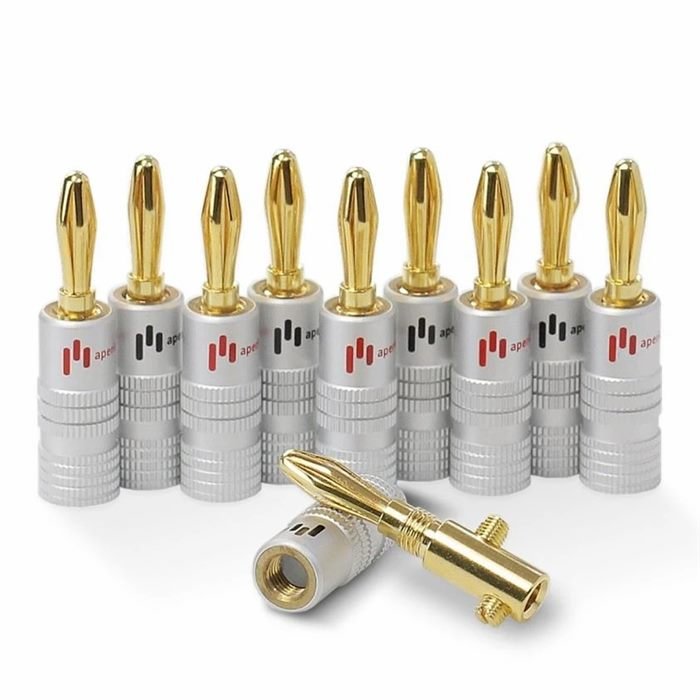
Why it's on this list: Most banana plugs, including every other pick on this page, top out around 16–18 AWG. These accept wire up to 8 AWG — the range you actually need if you're running thick-gauge wire to a dedicated power amp or subwoofer, like the Aperion Energy Pro E3H we run our own front three channels through. Pure copper with 24K gold plating, an aluminum jacket, and a solderless dual screw lock that needs nothing but a screwdriver.
Worth knowing: At $45 for 5 pairs, this is the priciest pick on this page by a wide margin. You're paying for 8 AWG headroom and Aperion's 5-year warranty and lifetime support, not a better-sounding connection — if your wire is 16 AWG or thinner, one of the cheaper picks above will do the same job.
- Quantity: 5 pairs (10 plugs)
- Plating: 24K gold over pure copper
- Wire range: Up to 8 AWG
- Lock type: Dual screw lock, solderless
- Warranty: 5-year, lifetime support
Why cable quality actually matters here
An RCA interconnect is the stereo (left/right) cable connecting a Blu-ray player, streaming box, turntable, or other component to your receiver — or, less commonly, a mono cable feeding a subwoofer. It's an easy thing to buy the cheapest option on, and usually fine to — but a couple of real differences separate a good one from a bad one. If you're feeding a separate power amp with balanced inputs, like the Aperion Energy series, an XLR cable belongs on this list too — see the picks below.
Shielding stops hum and buzz
An unshielded or poorly shielded cable can pick up hum from nearby power cords, dimmer switches, or a cable run through a wall alongside AC wiring. Dual-shielded designs (foil plus braid) are cheap insurance against a problem that's annoying to diagnose after the fact.
A loose RCA plug is a common failure point
A connection that buzzes intermittently or a channel that occasionally drops out is, more often than not, a plug that doesn't grip the jack tightly — not a bad component or a bad receiver. A well-made connector with real spring tension avoids this entirely.
Do expensive interconnects sound different?
For a standard line-level analog connection — a Blu-ray player or streaming box into a receiver — controlled blind listening tests consistently fail to find an audible difference between a well-shielded budget cable and a much pricier one at typical home theater run lengths. Buy for shielding and build quality here, not marketing claims about improved soundstage.
What to actually look for
- Double shielding: a foil layer plus a braided layer meaningfully cuts interference versus a single foil layer alone — worth prioritizing over connector bling.
- Length matches the run: buy for the actual distance plus a little slack for routing, not a cable twice as long coiled up behind the rack — excess length is just more antenna for noise to couple into.
- "2RCA to 2RCA" is just left/right: that's the standard way to connect any component with stereo analog outputs — a Blu-ray player, turntable phono stage, or CD player. If you're feeding a subwoofer instead, note that some "subwoofer cables" are sold as a bundled stereo pair rather than the single mono cable a sub actually uses — you'd only need one of the two.
- Gold-plated connectors: resist corrosion the way they do on banana plugs, but matter less here since these get plugged in once and rarely touched again — prioritize a tight physical fit over plating.
- RCA vs. XLR (balanced): use RCA for standard component-to-receiver connections. If your gear has XLR jacks — common on dedicated power amps, including all of the Aperion Energy amplifiers — a balanced XLR cable uses a dedicated shield conductor instead of relying on the braid for signal return, which better rejects hum and avoids ground loop issues over a long run.
| RCA cable | Best for | Price tier | Our rating | |
|---|---|---|---|---|
| Primeda Audiophile 2RCAWhat we use | A component or amp sitting right next to the rack | $ | 4.5 / 5 | Details ↓ |
| Amazon Basics 2 RCABest for longer runs | A component placed well away from the rack | $ | 4.6 / 5 | Details ↓ |
| Monoprice Onix SeriesBest value | Solid shielding without the markup | $ | 4.6 / 5 | Details ↓ |
| AudioQuest EvergreenPremium pick | Readers who want audiophile-grade build quality | $$$$ | 4.5 / 5 | Details ↓ |
| Aperion Audio RCA CableBest Aperion match | Feeding a subwoofer or an Aperion amp's RCA input | $$ | 4.9 / 5 | Details ↓ |
| Aperion Audio XLR CableBest for balanced amp inputs | Feeding an Aperion Energy amp's XLR input | $$ | 5.0 / 5 | Details ↓ |
Why we picked it: This is the cable we currently use to connect our Blu-ray player and other components to the receiver — and it's also what feeds unbalanced RCA pre-out signal from the receiver into our Aperion Audio Energy Pro E3H power amp. It's a proper 2RCA-to-2RCA stereo (left/right) pair with a 4N oxygen-free copper core and thick 3U gold-plated connectors, wrapped in a genuinely nice-looking braided nylon jacket rather than plain black rubber. At 1.6 feet (0.5M), it's built for exactly the kind of short, tight run you need between a receiver and a component or amp sitting right next to it — connectors seat snugly and it's held up without issue.
- Length: Ours is 1.6 ft (0.5M) — also sold in 3 ft (1M) and 6 ft (2M)
- Conductor: 4N oxygen-free copper
- Connectors: 3U gold-plated
- Jacket: Braided nylon
Why it's on this list: Nothing about this one is exciting, and that's the point — it's double-shielded, has real 24K gold-plated connectors, and is sold in 4, 8, and 15-foot lengths, so it actually reaches across a room instead of just claiming to. The other real advantage: it's an Amazon house brand, so it doesn't disappear from stock the way smaller third-party cable listings tend to — a genuine, if unglamorous, upside after chasing down a couple of discontinued picks for this page.
- Lengths: 4 ft, 8 ft, or 15 ft
- Shielding: Double-shielded
- Channels: 2-channel stereo (RCA to RCA)
- Connectors: 24K gold-plated
Why it's on this list: Same logic as the Monoprice banana plugs above — a trusted, decades-old AV brand selling well-shielded basics without a premium name tax. The Onix Series is double-shielded with copper braiding and gold-plated connectors, a genuine step up from the bargain-bin RCA cables sold for a couple dollars, at a price barely higher than they charge.
- Shielding: Double-shielded, copper braiding
- Connectors: Gold-plated
- Channels: 2-channel stereo (RCA to RCA)
Why it's on this list: AudioQuest is a genuinely respected name in cabling, and Evergreen is their entry-level stereo interconnect — sold as a proper matched left/right pair, built with Long-Grain Copper (LGC) conductors that reduce the signal distortion introduced at grain boundaries in cheaper metal. It's a real step up in construction over anything else on this list, and it's built to outlast the gear it's connecting.
Worth knowing: We're including this for readers who want it, not because we think it's the best value here. Per the honest take above, a standard line-level stereo connection is not where most listeners will hear a cable upgrade — this is a build-quality and peace-of-mind purchase, not a guaranteed sound-quality one, and it costs several times more than the other options on this page for it.
- Conductor: Long-Grain Copper (LGC)
- Configuration: Matched stereo pair (2 cables)
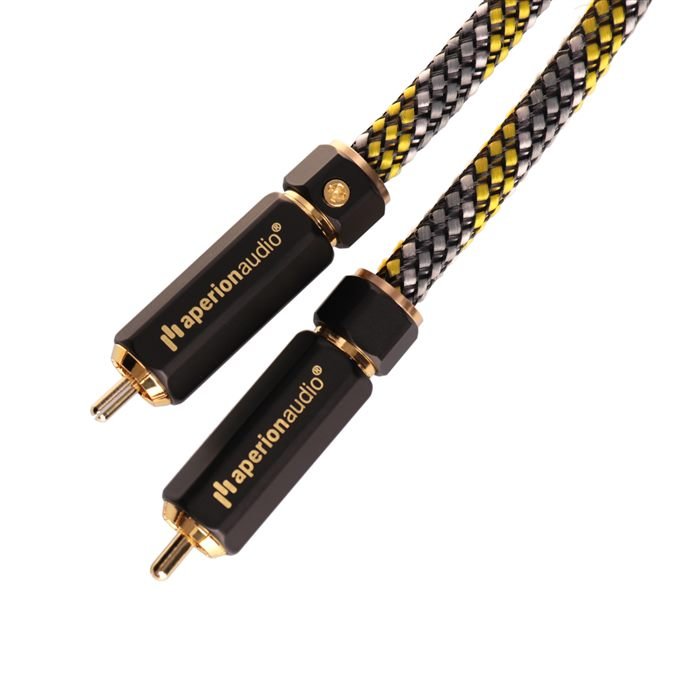
Why it's on this list: This is Aperion's own mono RCA cable — sold as a single male-to-male cable rather than a stereo pair, which is exactly what you want for a subwoofer run or for feeding a single RCA input on an Aperion Energy amplifier. It's built with 99.99% oxygen-free copper, double shielded (aluminum foil plus copper braid), and terminated with heavy-duty 24K gold-plated connectors, wrapped in a double-braided nylon jacket rated for 15,000+ bends.
- Lengths: 3 ft (1M), 6 ft (2M), 9 ft (3M), 16 ft (5M)
- Conductor: 99.99% 4N oxygen-free copper
- Shielding: Double-shielded — aluminum foil and copper braid
- Connectors: 24K gold-plated
- Configuration: Mono, single cable (not a stereo pair)
- Warranty: 5-year limited, lifetime support
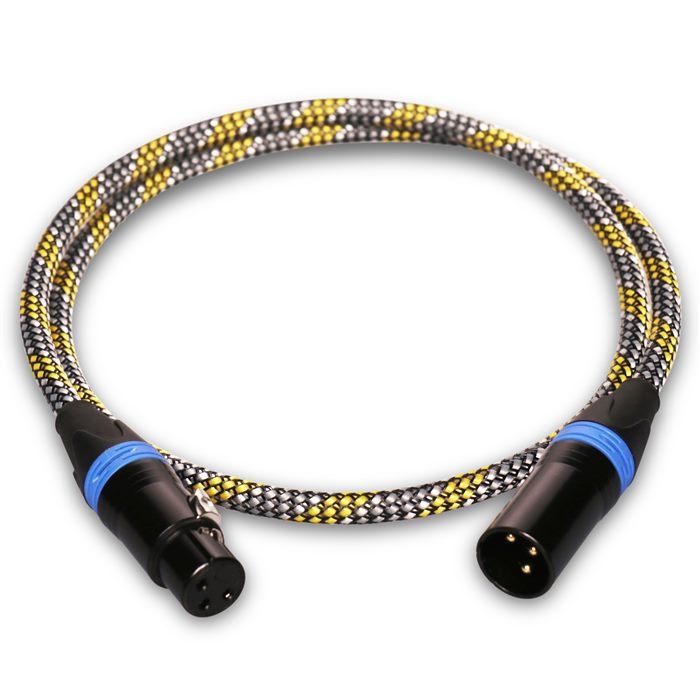
Why it's on this list: Every amp in the Aperion Energy lineup accepts balanced XLR alongside unbalanced RCA, and a balanced connection is the better choice once a cable run gets long — it uses a dedicated shield conductor rather than relying on the braid for signal return, which better rejects hum and avoids ground loop issues that an unbalanced RCA run can pick up. This is Aperion's own male-to-female XLR cable, built with the same 99.99% oxygen-free copper and 24K gold-plated connectors as their RCA cable above.
- Lengths: 3, 9, 16, 20, 26, or 32 ft
- Conductor: 99.99% 4N oxygen-free copper
- Shielding: Double-shielded, dedicated balanced return
- Connectors: 24K gold-plated, 3-pin XLR male to female
- Warranty: 5-year manufacturer's warranty, lifetime support
Gauge and copper quality actually matter
Speaker wire carries real current, not a line-level signal — which means the physical length of the run and the quality of the copper inside the jacket have a real, measurable effect on how much power actually reaches the speaker. It's the one accessory on this page where "just buy something" can genuinely cost you performance.
Thicker wire matters more as runs get longer
Resistance builds up over distance, so a run that's fine at 16 AWG for 20 feet can measurably rob power over a 100-foot run to a rear surround or an outdoor speaker. As a rough rule: 16 AWG for short runs, 14 AWG for most rooms, 12 AWG once you're past 50–75 feet or driving a subwoofer or amp with real current on tap.
OFC vs. CCA — read past the headline
Oxygen-free copper (OFC) conducts efficiently and holds up over years of flexing and connecting. Copper-clad aluminum (CCA) is cheaper and often marketed right alongside it — it has meaningfully higher resistance and is more prone to breaking at the strands. Check the actual conductor material, not just whether the word "copper" appears in the title.
Does exotic wire actually sound better?
Beyond adequate gauge for the run and genuine OFC copper, thicker cable, fancier jacketing, or exotic marketing claims don't produce a measurable, let alone audible, improvement. Buy for the length and power you're actually running, not the specs on a premium box.
What to actually look for
- Match gauge to the run, not just "thicker is better": overbuying gauge for a short run to a bookshelf speaker just costs more and is harder to route; underbuying for a long run to a sub or outdoor speaker costs you real output.
- In-wall or in-ceiling runs need a CL2 or CL3 rating: this is a fire-safety code requirement in most jurisdictions if the wire is going behind drywall, through a ceiling, or in a crawl space — not just a nice-to-have. CL3 outdoor-rated wire covers direct burial and full weather exposure too. See our guide to running wire through walls for how to actually fish it through cleanly.
- Buy more than the tape-measure distance: wire runs around doorframes, up walls, and through joists, so budget 20–30% over a straight-line measurement.
- Terminate the ends properly: see the banana plugs section above rather than leaving bare, fraying wire twisted into a binding post.
| Speaker wire | Best for | Price tier | Our rating | |
|---|---|---|---|---|
| MaxBrite 12AWGWhat we use | A dependable everyday spool | $ | 4.5 / 5 | Details ↓ |
| GearIT OFC 12AWG (CL3)Best for outdoor & burial | Patio speakers or buried runs | $$ | 4.7 / 5 | Details ↓ |
| Monoprice Access SeriesBest value / bulk spool | Wiring a whole system at once | $ | 4.6 / 5 | Details ↓ |
| KnuKonceptz KordPremium copper purity | Enthusiasts who want the best conductor | $$ | 4.6 / 5 | Details ↓ |
| Monoprice 16AWGBest for short runs | Bookshelf speakers or a nearby center channel | $ | 4.6 / 5 | Details ↓ |
Why we picked it: This is the wire we reach for by default. It's 12-gauge, 99.99% oxygen-free copper, and already UL Listed Class 2 — meaning it's cleared for in-wall and in-ceiling runs without hunting down a separate fire-rated cable. A 50-foot spool covers a couple of speaker runs in a typical room without paying for length you'll never use.
- Gauge: 12 AWG
- Conductor: 99.99% oxygen-free copper
- Rating: UL Listed Class 2 (in-wall safe)
- Length: 50 ft spool
Why it's on this list: Standard in-wall-rated (CL2) wire isn't rated for direct burial or real outdoor exposure — this is. GearIT's OFC line carries a CL3 rating that covers outdoor use, direct burial in ground, and in-wall runs in the same cable, with a UV-resistant jacket and foot markers printed along the length so you can measure a run without unspooling the whole reel. The right call for patio or backyard speakers, not just an indoor upgrade.
- Gauge: 12 AWG
- Conductor: OFC (oxygen-free copper)
- Rating: UL CL3 (outdoor, direct burial, in-wall)
- Length: 100 ft
Why it's on this list: Same logic as the other Monoprice picks on this page — a trusted brand selling genuinely good basics without a premium markup. It's 99.9% oxygen-free bare copper, CL2-rated for in-wall use, and sold in a 100-foot spool — enough to wire an entire 5.1 or 7.1 system's worth of runs from a single purchase instead of piecing together several shorter cuts.
- Gauge: 12 AWG
- Conductor: 99.9% oxygen-free bare copper
- Rating: CL2 (in-wall safe)
- Length: 100 ft spool
Why it's on this list: KnuKonceptz built its name in car audio, where delivering real current through tight, awkward spaces matters — the Kord line carries that over with a high strand count of oxygen-free copper that stays noticeably more pliable than stiffer bulk wire, which makes a real difference threading it through a tight run behind a rack or up a wall cavity. Reviewers consistently single out how easy it is to work with, on top of the copper quality itself.
- Gauge: 12 AWG
- Conductor: Oxygen-free copper, high strand count
- Length: 100 ft
Why it's on this list: Every other pick here is 12 AWG, which is overkill — and more expensive and harder to route — for a bookshelf pair or center channel sitting a short distance from the receiver. This is the same Access Series as our bulk 12AWG pick above, just in the gauge that actually matches a short run: 99.9% oxygen-free bare copper, CL2-rated for in-wall use, in a 100-foot spool.
- Gauge: 16 AWG
- Conductor: 99.9% oxygen-free bare copper
- Rating: CL2 (in-wall safe)
- Length: 100 ft spool
The cable matters more than you'd think
For standard 4K streaming and Blu-ray, almost any real HDMI cable works. For 4K/120 gaming, 8K, or full-bandwidth eARC, the cable itself becomes the bottleneck if it isn't actually certified for it — we cover the full "why" in our HDMI 2.1 explained guide. Here's what we'd actually buy.
The short version
- Look for actual "Ultra High Speed HDMI Cable" certification — the specific badge with a scannable authentication code — not just a box printed with "8K" or "2.1." Plenty of uncertified cables claim the spec without meeting it.
- Past roughly 10–15 feet, copper cables get meaningfully more prone to dropouts at full 48Gbps. A fiber optic HDMI cable solves this for longer or in-wall runs.
- Buy the length you need, plus a little slack — a coiled-up 15-foot cable behind a TV that's 6 feet from the receiver is just clutter.
| HDMI cable | Best for | Price tier | Our rating | |
|---|---|---|---|---|
| Aperion Audio CopperWhat we'd recommend | A standard rack-to-TV run | $$ | 4.7 / 5 | Details ↓ |
| Aperion Audio Fiber OpticBest for long runs | A projector or in-wall run across the room | $$$$ | 4.6 / 5 | Details ↓ |
| Monoprice 8K CertifiedBest value | A budget-conscious, in-wall-safe pick | $ | 4.6 / 5 | Details ↓ |
| Cable MattersBest-known brand | Readers who want a familiar name | $$ | 4.6 / 5 | Details ↓ |
| Zeskit MayaBest-seller | The category's most popular certified pick | $$ | 4.7 / 5 | Details ↓ |
Why we picked it: This one is actually certified as an "Ultra High Speed HDMI Cable" — the real badge, not just a box that says "2.1" — rated for the full 48Gbps that 4K/120 and 8K/60 require. 24K gold-plated connectors, a four-layer shielded design, and a 5-year warranty with Aperion's lifetime support behind it, same as their amp and banana plugs elsewhere on this site.
- Length: 6.5 ft (2M)
- Certification: Ultra High Speed HDMI 2.1, 48Gbps
- Supports: 8K/60Hz, 4K/120Hz, eARC, Dolby Atmos, Dynamic HDR
- Warranty: 5-year, lifetime support
Why it's on this list: This is exactly the scenario the tip above is about — a copper cable run to a projector across the room, or fished through a wall, is where signal integrity at full 48Gbps gets genuinely risky. Fiber optic sidesteps that entirely, and Aperion sells it in 32-foot and 65-foot lengths most copper cables don't even offer. Same 24K gold connectors and 5-year warranty as their copper cable.
Worth knowing: Unlike the copper cable above, this listing doesn't state the official "Ultra High Speed HDMI" certification specifically — it's specced at 48Gbps and HDMI 2.1 compliant, which fiber optic design supports natively, but we'd still call the manufacturer if that certification badge matters to you. It's also directional (marked SOURCE and DISPLAY ends), so pay attention when installing it.
- Lengths: 32 ft or 65 ft
- Bandwidth: 48Gbps, HDMI 2.1 compliant
- Supports: 8K/60Hz, 4K/120Hz, eARC, Dolby Atmos, Dynamic HDR
- Warranty: 5-year, lifetime support
Why it's on this list: Same logic as the other Monoprice picks on this page — genuinely certified, genuinely CL2 in-wall rated, at a fraction of what other certified cables charge. The braided jacket keeps it from looking or feeling like the bargain-bin cable it's priced like.
- Length: 6 ft
- Certification: 8K Certified Ultra High Speed HDMI 2.1, 48Gbps
- Rating: CL2 (in-wall safe)
- Jacket: Braided
Why it's on this list: Cable Matters has built its whole reputation on connectivity cables specifically, rather than branching into them from chargers or routers, and it shows — genuinely certified 48Gbps, a braided jacket, and specs that actually exceed the gaming basics with 4K@240Hz support on top of the usual 8K/60 and 4K/120.
- Length: 6.6 ft (2M)
- Certification: Ultra High Speed HDMI, 48Gbps
- Supports: 8K/60Hz, 4K/240Hz, HDR
- Jacket: Braided
Why it's on this list: Zeskit built its reputation on this exact cable — certified 48Gbps, a tough braided jacket that resists kinking, and consistently strong reviews from buyers who'd previously struggled with cheaper cables dropping out at 4K/120 with HDR and full-bitrate audio running at once.
- Length: 6.5 ft
- Certification: Ultra High Speed HDMI, 48Gbps
- Supports: 8K/60Hz, 4K/120Hz, eARC, HDR10, Dolby Vision
- Jacket: Braided
A shelf isn't a substitute for a real stand
Setting a bookshelf speaker on a shelf, credenza, or media console gets the sound out of the box, but it rarely gets the tweeter to ear height, and coupling a cabinet to a piece of furniture adds resonance the speaker's designer never accounted for. A dedicated stand fixes both — see our bookshelf vs. floorstanding guide for how stand cost factors into that decision.
Gets the tweeter to ear level
Most bookshelf speakers are voiced assuming the tweeter sits at or near seated ear height, roughly 36 to 42 inches off the floor. A shelf or low credenza almost never lands there — a stand does, by design.
Decouples the cabinet from furniture
A speaker resting directly on a hard shelf transmits cabinet vibration straight into it, which can add boxiness and smear bass. A stand's spikes or isolation feet interrupt that path instead of amplifying it.
Fillable columns tighten bass response
Adding sand or steel shot to a stand's hollow columns loads it with mass, which reduces the stand itself resonating in sympathy with the speaker — a cheap, physical upgrade to perceived bass tightness that costs nothing but time.
Keeps a heavy cabinet from tipping
A speaker balanced on the edge of a shelf or a narrow console is a tip-over risk, especially around kids or pets. A properly sized stand with spiked or rubber feet plants the speaker securely on the floor instead.
What to actually look for
- Weight capacity with real margin: check the stand's rated load against your speaker's actual weight, not just whether it technically clears it — a stand rated barely above your speaker's weight leaves no margin for a snug top-plate connection.
- Fillable columns: hollow steel or aluminum columns that accept sand or steel shot add meaningful mass and damping over an unfilled stand at the same price.
- Spikes for carpet, dishes or rubber feet for hard floors: most quality stands include both — spikes pierce through carpet pile to the subfloor, dishes or rubber feet protect hardwood or tile from the spikes.
- Top plate size vs. your speaker's base: the plate should support the full footprint of the cabinet, not just the center — an oversized or undersized plate undermines the stability the stand is there to provide.
- Built-in cable management: a hollow center column that routes speaker wire internally keeps the run out of sight instead of dangling down the outside of the stand.
| Speaker stand | Best for | Price tier | Our rating | |
|---|---|---|---|---|
| Aperion Audio Premium Speaker StandWhat we'd recommend | Matching an Aperion bookshelf or surround speaker | $$$$ | 4.8 / 5 | Details ↓ |
| Monolith by Monoprice 28"Best value | Serious build quality without the premium price | $ | 4.6 / 5 | Details ↓ |
| Kanto SP26PLBest for swivel adjustment | Dialing in toe-in after the stand is placed | $$ | 4.7 / 5 | Details ↓ |
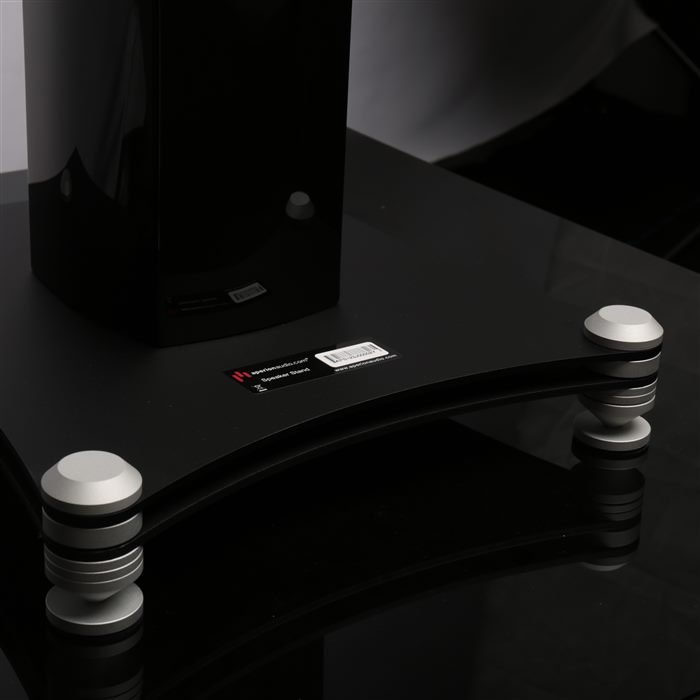
Why we picked it: This is the natural pairing for the Novus N6B, Verus V8B, or Grandis GR8 bookshelf speakers elsewhere on this site — same gloss piano black finish, and built to genuinely disappear into the room rather than just prop a speaker up. A wood column sits on a weighted aluminum base with hardened steel sheets underneath for a bottom-heavy, low-resonance platform, and it lands speakers at a 29" listening height with a 220 lb load rating that leaves real margin over almost any bookshelf speaker on the market. Cable management is routed internally through the column instead of zip-tied down the outside, and it ships pre-assembled.
Worth knowing: At $349 each, this is the priciest pick on this page. You're paying for the aesthetic match to Aperion's own speakers and their 5-year warranty with lifetime support, not a functional advantage over the Monolith pick below — if brand-matched looks don't matter to you, the Monolith stand hits a very similar spec sheet for a fraction of the price.
- Height: 29" (with feet attached)
- Load capacity: 220 lb
- Finish: Gloss piano black, wood column
- Feet: Aluminum spikes (carpet) and dishes (hard floors)
- Warranty: 5-year, lifetime support
Why it's on this list: Same logic as the other Monoprice picks on this page — a trusted brand hitting nearly every spec that matters at a fraction of what a premium stand charges. Four rectangular steel columns can each be filled with sand or steel shot for real vibration damping, it's rated for a genuinely high 100 lb load, and it comes with adjustable spikes for carpet. The scratch-resistant black powder coat finish looks considerably more expensive than the price suggests.
- Height: 28" (24" and 32" also available)
- Load capacity: 100 lb
- Construction: Fillable steel columns
- Feet: Adjustable spikes
- Sold: Individually — buy two for a pair
Why it's on this list: The rotating top plate is the standout feature here — it lets you fine-tune toe-in angle after the stand is already placed and leveled, instead of having to lift and reposition the whole stand to aim the speaker at your listening position. Heavy-duty alloy steel with foam padding at the top plate for vibration control, two top plate sizes included to fit different speaker footprints, and interchangeable spiked or rubber feet for carpet or hardwood. Sold as a matched pair rather than individually.
- Height: 26" (32" also available)
- Load capacity: 30 lb per stand
- Feature: Rotating top plate for toe-in adjustment
- Feet: Interchangeable spikes and rubber feet
- Sold: As a pair
Getting the wiring right is only half the job — the other half is where each speaker actually goes in the room.
Read the speaker placement guide →