Dolby Vision is the HDR format most streaming services and 4K Blu-rays use, yet plenty of projectors skip it, including every BenQ and Epson model we cover. Every pick below lists Dolby Vision on its maker's spec sheet, and we note which ones add HDR10+. Our picks lean on RTINGS' lab testing and are limited to projectors you can buy new on Amazon.
The best Dolby Vision projector for most people is the JMGO IRIS Ultra (about $1,899): RTINGS' mid-range pick, with excellent contrast, accurate color, and 4K at 120Hz for gaming. For the best picture, the XGIMI TITAN Noir (about $3,999) adds HDR10+ and IMAX Enhanced.
For less, the XGIMI HORIZON 20 (about $1,500) supports both Dolby Vision and HDR10+ and is brighter than the IRIS Ultra, and the XGIMI MIRA (about $1,444) is the most affordable Dolby Vision projector we recommend.
-
Best Dolby Vision projector for most peopleJMGO IRIS Ultra~$1,899 Check price on Amazon
-
Best picture with Dolby VisionXGIMI TITAN Noir~$3,999 Check price on Amazon
-
Best value with Dolby Vision and HDR10+XGIMI HORIZON 20~$1,500 Check price on Amazon
-
Brighter step-upJMGO IRIS Ultra Max~$2,999 Check price on Amazon
-
Best for dark-room movie nightsValerion VisionMaster Max~$3,499 Check price on Amazon
-
Best ultra short throw with Dolby VisionHisense PX4 Pro~$4,000 Check price on Amazon
-
Most affordable Dolby Vision pickXGIMI MIRA~$1,444 Check price on Amazon
-
Best outdoor projector with Dolby VisionAnker Nebula X1~$2,999 list Check price on Amazon
Prices are approximate and change often. Tap a name to jump to the full write-up.
- Quick comparison
- Best Dolby Vision projector for most people: JMGO IRIS Ultra
- Best picture with Dolby Vision: XGIMI TITAN Noir
- Best value with Dolby Vision and HDR10+: XGIMI HORIZON 20
- Brighter step-up: JMGO IRIS Ultra Max
- Best for dark-room movie nights: Valerion VisionMaster Max
- Best ultra short throw with Dolby Vision: Hisense PX4 Pro
- Most affordable Dolby Vision pick: XGIMI MIRA
- Best outdoor projector with Dolby Vision: Anker Nebula X1
- Also worth a look
- Popular projectors without Dolby Vision
- Does Dolby Vision matter on a projector?
- What you need to watch in Dolby Vision
- Frequently asked questions
Quick comparison
| Projector | Type | HDR formats | Price |
|---|---|---|---|
| JMGO IRIS Ultra | Short throw | Dolby Vision, HDR10 | ~$1,899 |
| XGIMI TITAN Noir | Short throw | Dolby Vision, HDR10+, HDR10 | ~$3,999 |
| XGIMI HORIZON 20 | Standard throw | Dolby Vision, HDR10+, HDR10 | ~$1,500 |
| JMGO IRIS Ultra Max | Short throw | Dolby Vision, HDR10 | ~$2,999 |
| Valerion VisionMaster Max | Short throw | Dolby Vision, HDR10+, HDR10, HLG | ~$3,499 |
| Hisense PX4 Pro | Ultra short throw | Dolby Vision, HDR10+, HDR10, HLG | ~$4,000 |
| XGIMI MIRA | Ultra short throw | Dolby Vision, HDR10, HLG | ~$1,444 |
| Anker Nebula X1 | Portable / outdoor | Dolby Vision, HDR10 | ~$2,999 list |
HDR formats: each pick lists the HDR formats its maker supports. Dolby Vision is highlighted because it's the format most streaming services and 4K Blu-rays use, and plenty of projectors skip it. Dolby Vision and HDR10+ adjust brightness scene by scene; basic HDR10 uses one setting for the whole movie. How HDR10, HDR10+, and Dolby Vision differ.
RTINGS made it the mid-range pick on both its 4K and short-throw lists in November 2026. Its contrast is excellent, so dark scenes keep their depth, and its color is wide and accurate out of the box. It supports Dolby Vision, and an adjustable dual iris lets you trade a little brightness for deeper blacks. It's also one of the few projectors that accepts 4K at 120Hz, plus 1080p at 240Hz with VRR, so it doubles as a great gaming projector. A motorized zoom, lens shift, and a gimbal stand make it easy to line up, and Google TV is built in.
Worth knowing: it washes out with more than a couple of dim lights on, and it can't remove judder from 25fps international content. There's no HDR10+, so HDR10+ titles play in basic HDR10 instead.
Check price on Amazon Prices change often — verify current pricing on Amazon.The best picture of any 4K projector we can link on Amazon. RTINGS measured better contrast than most projectors on the market, so blacks look deep in dark scenes, and colors are outstanding. It supports both scene-by-scene HDR formats, Dolby Vision and HDR10+, along with IMAX Enhanced. A motorized zoom lens and lens shift make it far easier to line up with a screen than budget models, and it removes judder from most sources.
Worth knowing: there's no built-in smart platform, so you'll need a streaming device that outputs Dolby Vision, such as an Apple TV 4K or Google TV Streamer.
Check price on Amazon Prices change often — verify current pricing on Amazon.About as bright and colorful as the TITAN Noir for much less, with Google TV built in so it works on its own. Unlike the IRIS Ultra, it supports HDR10+ as well as Dolby Vision, and it's quite a bit brighter, so it holds up better with some room light. RTINGS rates its contrast very good, and it handles 4K at 60Hz or 1080p up to 240Hz with VRR.
Worth knowing: its contrast is noticeably lower than the IRIS Ultra's, so blacks aren't as deep. Removing judder drops the resolution to 1080p, and input lag is fine for story games but not competitive ones.
Check price on Amazon Prices change often — verify current pricing on Amazon.The IRIS Ultra with more light. In RTINGS' testing it's a lot brighter, so the picture is punchier in a dark room and holds up better with some lights on, and its contrast is fantastic. Dolby Vision, 4K 120Hz gaming, Google TV, and the two HDMI 2.1 ports all carry over, and a motorized gimbal lets you aim it with the remote.
Worth knowing: RTINGS says the extra cost isn't worth it for most people who watch in a dark room, and it calls the motorized gimbal a bit gimmicky. Like the IRIS Ultra, it doesn't support HDR10+.
Check price on Amazon Prices change often — verify current pricing on Amazon.It supports every major HDR format, Dolby Vision, HDR10+, HDR10, and HLG, plus IMAX Enhanced. Its native contrast is excellent, and its dynamic iris genuinely deepens blacks without obvious artifacts, so dark scenes have real weight. Judder handling is fantastic for smooth camera pans, and its anti-rainbow feature helps people who are sensitive to DLP color flashes.
Worth knowing: its brightness is right for a dim or dark room, not a sunny living room, and its zoom range reaches beyond typical short-throw distances, so check the throw distance for your room.
Check price on Amazon Prices change often — verify current pricing on Amazon.It sits inches from the wall and covers every major HDR format: Dolby Vision, HDR10+, HDR10, and HLG, plus IMAX Enhanced certification. Hisense rates its RGB triple laser at 3,500 ANSI lumens and 118% of BT.2020 color, and its 66W Devialet-tuned 4.0.2 Dolby Atmos system, with two up-firing speakers, is strong enough to run without a soundbar at first.
Worth knowing: it runs Hisense's VIDAA platform, which has a smaller app catalog than Google TV, and like any DLP projector it can show rainbow artifacts to sensitive viewers. The AWOL Aetherion Max (~$4,499) and Aetherion Pro (~$2,499) also support Dolby Vision and HDR10+; see PX4 Pro vs Aetherion Max.
Check price on Amazon Prices change often — verify current pricing on Amazon.The least expensive projector we recommend with Dolby Vision. It's an ultra short throw, so it sits just in front of the wall, and it has vibrant, accurate color out of the box, Google TV built in, and Harman Kardon speakers. It supports HDR10 and HLG as well, but not HDR10+.
Worth knowing: it's dimmer than the AWOL Aetherion Pro, it can only remove judder by dropping to 1080p, and people sensitive to DLP rainbow artifacts may notice them.
Check price on Amazon Prices change often — verify current pricing on Amazon.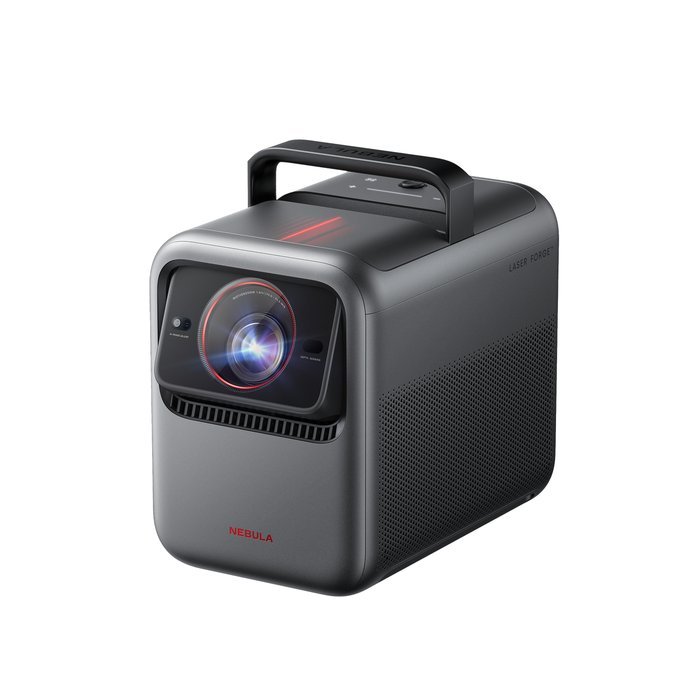 Image: Soundcore
Built for the backyard first. Its triple-laser engine is rated at 3,500 ANSI lumens, enough to hold a vivid 4K picture with patio lights on, and it supports Dolby Vision. A retractable handle, motorized zoom, autofocus, and automatic keystone correction make setup outside quick, and Google TV means no streaming stick to carry out.
Worth knowing: there's no built-in battery, it isn't weatherproof, it weighs 13.7 lbs, and it doesn't support HDR10+. See our outdoor projector guide for cheaper options without Dolby Vision.
Check price on Amazon Check price at Soundcore Prices change often — verify current pricing before you buy.Also worth a look
- JMGO N3 Ultimate (~$2,199): a bright short-throw projector with Dolby Vision, RTINGS' alternative when brightness comes first. See our short-throw projector picks.
- AWOL Vision Aetherion Pro (~$2,499): an ultra short throw with Dolby Vision and HDR10+ for a dark room. See our best 4K projectors.
- XGIMI Horizon 20 Pro: the brighter HORIZON 20, with Dolby Vision and HDR10+. See our outdoor projector picks.
Popular projectors without Dolby Vision
These are good projectors, and several are on our other lists, but none of them list Dolby Vision. They play Dolby Vision titles in basic HDR10 instead.
- BenQ (TK710, TK710STi, X3100i, X500i): HDR10 only (the TK710 pair adds HLG), and no HDR on the 1080p TH671ST. See our BenQ projector guide.
- Epson LS11000 and JVC DLA-NZ500: HDR10+ instead of Dolby Vision, plus HDR10 and HLG. Both also adjust HDR on the fly with their own processing (Epson's real-time HDR adjustment and JVC's Frame Adapt HDR).
- Epson 5050UB and Lifestudio Grand: HDR10, and HLG on the Lifestudio Grand.
- Budget and portable models: the XGIMI Elfin Flip 4K and Elfin Flip Laser, JMGO N1S 4K, NexiGo PJ40 Pro, and Nebula Capsule 3 Laser and Mars 3 Air support HDR10 at most.
Does Dolby Vision matter on a projector?
More than you might expect. Projectors can't get anywhere near as bright as HDR movies are mastered for, so every projector has to squeeze the movie's brightness range into what it can show, a process called tone mapping. Dolby Vision and HDR10+ include scene-by-scene brightness information that helps the projector do this more precisely. With basic HDR10, it gets one set of numbers for the whole movie, so very dark or very bright scenes are more likely to look flat or clipped.
The format isn't everything, though. A projector's own processing matters too, and some high-end models without Dolby Vision analyze the picture themselves to get a similar result. Contrast and brightness still make the bigger difference you'll see, which is why our rankings start there. Want the full background? Read Dolby Vision vs HDR10 vs HDR10+.
What you need to watch in Dolby Vision
- A source that outputs it: the built-in Google TV apps on most of these picks, a streaming device such as the Apple TV 4K or Google TV Streamer, or a 4K Blu-ray player with Dolby Vision.
- Dolby Vision content: Netflix, Prime Video, Disney+, and Apple TV all stream in Dolby Vision on supported devices. Netflix needs its Premium plan for 4K and HDR.
- Everything in between: if the signal passes through an AV receiver or HDMI switch, that device has to pass Dolby Vision too. Check its spec sheet before you buy.